
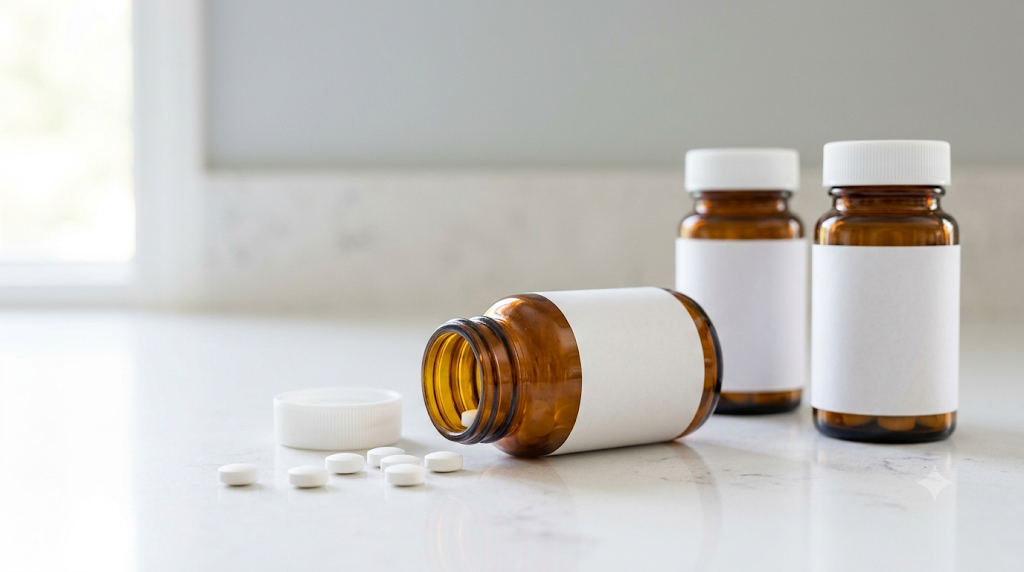
The most common prescription mistakes in family homes are measuring liquid medicine with a kitchen spoon, storing medicine somewhere a child can reach, and giving one family member’s prescription to another. All three are preventable. The American Academy of Pediatrics recommends dosing all liquid medications in milliliters only, using an oral syringe rather than any household spoon, because kitchen spoons vary widely in size. Storage matters just as much, since most childhood medication overdoses happen when a child finds medicine without an adult present. The pharmacists at Crystal Lake Pharmacy can supply proper dosing devices and answer these questions directly. Below are the mistakes worth knowing, from toddlers through teenagers to older parents.
How Often Do Family Medication Mistakes Happen
More often than most parents realize, and the pattern is consistent.
Data from the CDC’s medication safety surveillance estimates approximately 35,000 emergency department visits each year from unintentional medication overdoses among children under age five in the United States. Put another way, about 1 out of every 250 two-year-olds is treated in an emergency department for an unintentional medication overdose.
The circumstances are the important part. The large majority of these visits happen because a child found and took medicine without adult supervision, rather than because a caregiver gave a wrong dose. That makes storage the highest-value fix in most homes.
Adults are not exempt. The CDC report published in its Morbidity and Mortality Weekly Report found that among prescriptions that get filled, roughly 50% are taken incorrectly, most often in timing, dosage, frequency, or duration.
Mistake 1: Measuring Liquid Medicine With a Kitchen Spoon
A kitchen teaspoon is not a unit of measurement. Household spoons vary substantially in volume, which is why both the American Academy of Pediatrics and the U.S. Food and Drug Administration advise against using them for medicine.
In its 2015 policy statement published in Pediatrics, the AAP recommended that liquid medications be dosed exclusively in milliliters, that teaspoon and tablespoon dosing not be used, and that syringes with metric markings be the preferred device and be given out with the medication.
The labeling itself drives behavior. In a randomized study of more than 2,000 caregivers reported by the AAP, parents were over four times more likely to reach for a kitchen spoon when the dose was written in teaspoons rather than in metric units.
| Device | Accuracy | Notes |
| Oral syringe with mL markings | Best | Preferred for small doses and for any dose under 5 mL |
| Dosing cup with mL markings | Acceptable | Higher error rates than syringes, especially for partial doses |
| Dropper | Acceptable for very small volumes | Common with infant medications |
| Kitchen teaspoon or tablespoon | Not acceptable | Volume varies widely between spoons |
Practical habits:
- Ask the pharmacy for an oral syringe sized close to the dose you need
- Ask to have the label written in mL if it currently shows teaspoons
- Watch for the decimal. A dose of 0.5 mL is not 5 mL, and that tenfold difference is a known source of serious errors
- Have the pharmacist demonstrate the measurement once, then repeat it back
Mistake 2: Storing Medicine Where a Child Can Reach It
Child-resistant caps slow a child down. They do not stop one.
Storage habits that work:
- Keep every medicine and supplement up, away, and out of sight, not merely out of reach
- Close the cap fully every single time, including between doses on a sick day
- Store medicine in a cool, dry place rather than the bathroom cabinet, since heat and humidity degrade many products
- Ask visiting relatives to keep purses, coat pockets, and overnight bags out of reach, because a grandparent’s daily pill organizer is one of the most common sources of exposure
- Keep pet medications stored just as carefully
Never leave a dose sitting on a counter for later. That is the single most common shortcut behind an accidental ingestion.
Mistake 3: Calling Medicine Candy
It works in the moment and creates a lasting risk. A child told that medicine tastes like candy has been given a reason to look for it later.
Better approaches:
- Call it medicine, and explain that medicine is only given by a parent or caregiver
- If taste is the real obstacle, ask the pharmacy about a flavored compounded formulation rather than negotiating with a bad flavor
- Explain to older children why they should never take a sibling’s medicine
Mistake 4: Treating Gummies and Supplements as Harmless
Supplements in gummy form look like sweets, and children treat them accordingly.
CDC data illustrate the scale. Melatonin was implicated in 7% of all emergency department visits for unsupervised medication exposures among infants and young children during 2019 through 2022, accounting for roughly 11,000 visits. Poison center calls for pediatric melatonin exposures rose sharply over the preceding decade. In an analysis of 2017 through 2020 data, the over-the-counter products most often involved in these visits were acetaminophen, melatonin, and ibuprofen.
Treat vitamins, melatonin, and herbal products with the same storage rules as prescriptions, and add them to your household medication list so a pharmacist can check for interactions.
Mistake 5: Giving One Family Member’s Prescription to Another
Sharing a leftover antibiotic, or giving a child a smaller piece of an adult tablet, skips every safety check that exists. Doses depend on weight, age, kidney function, diagnosis, and everything else the person takes. Antibiotics in particular are matched to a specific organism.
This applies within families and across generations. It also applies to pets, which should never receive human medication without veterinary direction, since several common human drugs are toxic to dogs and cats.
Mistake 6: Doubling Up on the Same Active Ingredient
The same drug hides under different names, which is how doubling happens without anyone being careless.
Acetaminophen is the clearest example. It appears in many prescription combination products, often alongside an opioid, and in a long list of over-the-counter pain, cold, and sleep products. The U.S. Food and Drug Administration has stated that overdose from prescription combination products containing acetaminophen accounts for nearly half of all cases of acetaminophen-related liver failure in the United States. In 2011 the FDA asked manufacturers to limit acetaminophen in prescription combination products to no more than 325 mg per tablet or capsule and required a boxed warning about severe liver injury.
Anti-inflammatory pain relievers layer in a similar way. In July 2015 the FDA strengthened its warning that non-aspirin anti-inflammatory drugs such as ibuprofen and naproxen can raise the chance of heart attack or stroke, noting the risk can appear within the first weeks of use.
Read active ingredients on every box, not brand names, and ask before combining anything with a prescription pain reliever.
Mistake 7: Stopping an Antibiotic Early
A child who feels better on day four still has a course to finish. Stopping early can leave an infection incompletely treated.
Two related habits to drop: saving the leftover half of a course for next time, and starting a leftover antibiotic for a new illness without a diagnosis.
Mistake 8: Keeping Leftover and Expired Medicine
Old bottles create confusion and access. A discontinued prescription sitting beside a current one invites the wrong tablet, and leftover medicine is a frequent source of both child exposures and teen misuse.
Clear out anything expired or no longer prescribed, and ask the pharmacy how to dispose of it properly rather than putting it in the household trash. Ask whether a local take-back option is available.
What Families With Teenagers Should Know
The risks shift with age. For teenagers, the concern moves from accidental ingestion to intentional use.
- Keep track of quantities for any controlled medication in the house, including stimulants and pain medications
- Store those medications separately and out of general access, even in a home with no young children
- Dispose of leftovers promptly rather than leaving them in a cabinet
- Talk about why sharing a prescription, including a stimulant before an exam, is not harmless
- Include your teenager in the pharmacy conversation about their own medications, so they learn the instructions directly
What to Do If a Child Takes Medicine by Accident
Act immediately, and do not wait for symptoms.
- Call Poison Help at 800-222-1222 right away. The line is staffed at all hours.
- Have the container in hand so you can read the name and strength.
- Do not try to make the child vomit unless a professional instructs you to.
- Call 911 instead if the child is unconscious, having trouble breathing, having a seizure, or cannot be woken.
- Save the packaging for the medical team.
Program the Poison Help number into your phone before you need it, and give it to anyone who cares for your children.
A Simple Family Medication Checklist
- One written list of everything everyone in the household takes, including supplements
- All prescriptions at one pharmacy so interactions get checked
- Proper mL dosing devices for every liquid, and labels written in mL
- Everything stored up, away, and out of sight, with caps closed fully
- Leftovers and expired medicine cleared out regularly
- Poison Help saved in every adult’s phone
- One annual medication review with a pharmacist, and current vaccinations for the family
Final Thoughts
Family medication mistakes come from ordinary moments rather than carelessness. A spoon is closer than the syringe. A dose gets set on the counter during a hard night with a sick child. A visiting grandparent’s bag ends up on the floor. A gummy vitamin looks like a treat. Each one has a small, permanent fix: measure in milliliters with a proper syringe, store everything up and out of sight, keep one list for the whole household, and clear out what nobody takes anymore.
If you have questions about a dose, a device, or how to store something safely, contact Crystal Lake Pharmacy or stop into the Crystal Lake pharmacy and ask a pharmacist.